OpenZhenZhen AI 提示词画廊 · gpt-image-2.5 · image
高级感复古半色调旅行设计海报
Premium Retro Halftone Travel Design Poster
来自 OpenNana 的旅行照片编辑模板。将每张实际上传的 travel_photo 独立制作成 3:4 高级亚洲复古半色调旅行海报;travel_photo 为必填文件输入,来源示例图不冒充用户源图,不需要人物身份绑定。
提示词 / Prompt
中文提示词
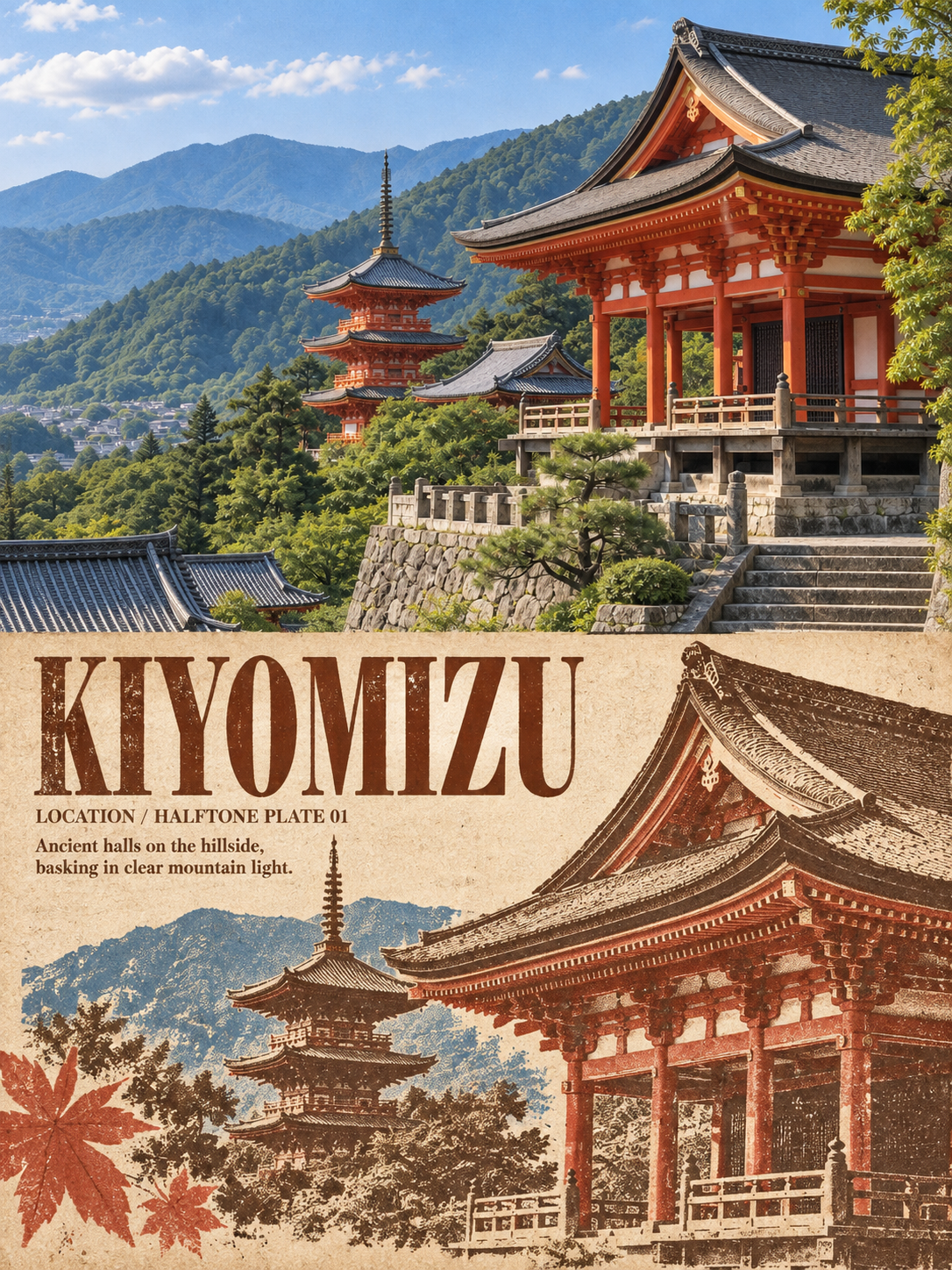
图1是为travel_photo生成的配套素材,作为本次编辑工作流对应位置实际使用的输入图像。 使用上传的 travel_photo 图像作为本次编辑的唯一来源照片。travel_photo 是实际由用户提供的文件输入;在文件上传前不要假设任何来源图像已经存在。 请将我上传的每一张旅行照片分别制作成一张独立的高级设计海报,每张照片单独输出,禁止将不同照片或不同地点拼接在同一张作品中。 整体采用3:4竖版构图,由真实摄影与风格化转绘构成清晰对照。 上半部分约占画面50%,忠实保留原始照片。准确保持主体身份、数量、姿态、建筑结构、地形关系、观察角度、真实材质、自然光影和原有色彩氛围,仅进行轻微的旅行杂志与艺术出版物调色,并加入极薄胶片颗粒。不得把照片重画成插画,不得增删人物、移动物体、改变建筑、镜像、拉伸或扭曲主体。 上下区域之间使用笔直、清晰、克制的水平边界,可保留一道很窄的暖色纸张间隔。不要渐变、羽化、溶解或让上下元素跨越边界。 下半部分将同一张照片重新构建为“复古亚洲网点旅行拼贴”。只从这张照片中提取2—4个真实存在、最具识别度的元素,例如地标建筑、人物、佛像、车辆、船只、岩石、屋顶、植物或道路。不得加入照片中不存在的其他地标、人物、交通工具或文化符号。 不要按照原照片的完整构图重新描画。主动改变主体尺度、裁切方式和空间关系: - 选择一个主体放大并大胆裁切,作为主要视觉锚点; - 将其余元素拆成大小不等的独立印版; - 允许元素叠压、错位、出画或形成不合摄影透视的编辑拼贴; - 删除复杂背景和微小细节; - 根据照片内容选择“缩小提炼”或“满版冲击”,不要机械套用固定模板; - 下半部分保留约30%—40%的连续米黄色空白纸面,让图形与文字能够呼吸。 使用温暖米黄色或象牙色旧纸,清楚呈现纸张纤维、颗粒、轻微污迹和年代感。图像采用黑褐色粗半调网点、手工剪切边缘、局部缺墨、油墨覆盖不均和轻微套色错位。 配色必须从原照片提取并压缩为有限色盘: - 黑褐色作为主要网点印版; - 最多加入两种低饱和专色; - 可选择钴蓝、靛蓝、灰蓝、砖红、陶土红、赭黄或照片中最具辨识度的颜色; - 只保留一处较鲜明颜色作为视觉强调; - 不要把所有地点固定成同一套红蓝配色。 文字必须事先根据照片的可靠地点与画面事实确定,并作为印刷媒介的一部分自然进入下半画面。默认包含: 1. 一个1—3个英文单词的地点或主题标题; 2. 一个简短字段,例如“LOCATION / HALFTONE PLATE 01”; 3. 一句5—12个英文单词的观察句,描述照片中真实可见的建筑、天气、动作或空间感受。 主标题使用清楚可读的窄衬线字体、老式铅字或复古出版字体,在聊天预览尺寸下仍能辨认。辅助文字可以稍小,但不能缩成装饰性细线。文字使用与画面相同的油墨,带有轻微缺墨、纸齿和套印偏差,不能像光滑的数字排版图层。 整体应像一页经过重新制版、裁切和套印的旧亚洲旅行刊物:安静、克制、粗粝、具有收藏感,同时保留清楚的地点身份和真实旅行记忆。 强制避免: 照片滤镜、上下同构图重画、多地点混合、泛亚洲文化符号、虚构地标、密集旅游图标、满版无留白、九宫格、平滑矢量、现代数字渐变、透明水彩、油画厚涂、卡通风格、廉价模板感、作者姓名、签名、社交账号、Logo、二维码、水印、乱码、假中文和提示词之外的额外文字。
English prompt
Image 1 is the generated supporting image for travel_photo; use it as the actual input for the corresponding slot in this editing workflow. Use the uploaded travel_photo image as the sole source photograph for this edit. Treat travel_photo as the actual user-provided file input; do not assume any source image is present before upload. Please turn every travel photo I upload into an independent high-end design poster, outputting each photo separately; it is forbidden to stitch different photos or different locations into the same work. The overall composition uses a 3:4 vertical layout, forming a clear contrast between real photography and stylized re-rendering. The upper part occupies about 50% of the frame, faithfully preserving the original photo. Accurately maintain the subject identity, quantity, posture, architectural structure, topographical relationships, observation angles, real materials, natural light and shadow, and the original color atmosphere, only performing slight travel magazine and art publication color grading, and adding extremely thin film grain. Do not redraw the photo into an illustration, do not add or delete characters, move objects, change buildings, mirror, stretch, or distort the subject. Use a straight, clear, and restrained horizontal boundary between the upper and lower areas; a very narrow warm-toned paper gap can be reserved. No gradients, feathering, dissolving, or letting elements from the top or bottom cross the boundary. The lower part reconstructs the same photo as a "Vintage Asian Halftone Travel Collage." Only extract 2–4 existing, most recognizable elements from this photo, such as landmark buildings, figures, Buddha statues, vehicles, boats, rocks, roofs, plants, or roads. Do not add other landmarks, people, vehicles, or cultural symbols not present in the photo. Do not redraw according to the complete composition of the original photo. Actively change the subject scale, cropping method, and spatial relationship: - Select one subject to enlarge and boldly crop as the main visual anchor; - Deconstruct the remaining elements into independent printing plates of varying sizes; - Allow elements to overlap, misalign, bleed out of the frame, or form an editorial collage that does not conform to photographic perspective; - Remove complex backgrounds and tiny details; - Choose "reduction and refinement" or "full-page impact" based on the photo content, do not mechanically apply a fixed template; - The lower part reserves about 30%—40% continuous beige blank paper space to allow graphics and text to breathe. Use warm beige or ivory old paper, clearly showing paper fibers, grain, slight stains, and a sense of age. Images use dark brown coarse halftone dots, hand-cut edges, partial ink shortage, uneven ink coverage, and slight color registration misalignment. The color scheme must be extracted from the original photo and compressed into a limited palette: - Dark brown as the main halftone printing plate; - Add at most two low-saturation spot colors; - Can choose cobalt blue, indigo, grey-blue, brick red, terracotta red, ochre yellow, or the most recognizable colors from the photo; - Retain only one vivid color as visual emphasis; - Do not fix all locations to the same red and blue color scheme. Text must be determined in advance based on the photo's reliable location and factual content of the frame, and naturally enter the lower frame as part of the printing medium. Default includes: 1. A location or theme title of 1—3 English words; 2. A short field, such as "LOCATION / HALFTONE PLATE 01"; 3. An observation sentence of 5—12 English words, describing the truly visible architecture, weather, action, or spatial feeling in the photo. The main title uses clear and readable narrow serif fonts, vintage lead types, or retro publishing fonts, recognizable even at chat preview size. Auxiliary text can be slightly smaller but cannot shrink into decorative thin lines. Text uses the same ink as the image, with slight ink shortage, paper tooth, and overprint deviation, and cannot look like a smooth digital layout layer. The overall style should be like a page of a re-plated, cropped, and overprinted old Asian travel publication: quiet, restrained, gritty, with a sense of collectability, while retaining a clear location identity and real travel memories. Mandatory Avoidance: Photo filters, upper/lower identical composition redrawing, multi-location mixing, pan-Asian cultural symbols, fictional landmarks, dense tourist icons, full-page without white space, nine-grid, smooth vectors, modern digital gradients, transparent watercolors, oil painting impasto, cartoon styles, cheap template feel, author names, signatures, social accounts, logos, QR codes, watermarks, garbled characters, fake Chinese, and extra text outside the prompt.
探索更多图片和视频提示词 · 生成图片 · 生成视频 · 在 AI 画布中创作
相关作品
- 暖橙影棚中的金色轮廓光男性时尚肖像
暖橙渐变影棚中的成年男性时尚肖像:男子微微抬头,留短而有质感的头发与修整整齐的胡须,穿黑色Polo衫;以柔和金色轮廓光突出面部和下颌,采用忧郁高对比度、清晰面部细节、浅景深与电影级色彩分级。
- 金色夕阳下的奢华阳台男性时尚肖像
成年男性阳台时尚肖像:深色太阳镜、浅粉亚麻衬衫、白色亚麻长裤与深棕乐福鞋;倚靠白色几何栏杆,左手插袋、右臂搭栏,左侧为深灰花盆与阔叶绿植,采用柔和金色傍晚光线和浅景深编辑摄影风格。
- 芥末黄摄影棚中的男性模特与前景太阳镜
3:4商业时尚产品海报:成年男性模特位于芥末黄无缝摄影棚背景前,穿浅米灰西装外套和白T恤;伸手在镜头前展示黑色亮面Wayfarer风格太阳镜,产品清晰、人物柔焦,左上硬光塑造阴影。ref-10a-v1仅为固定面部身份参考。
- 彩色城市巷道中的成年亚洲男性街头时尚人像
成年亚洲男性全身街拍,保留薰衣草色连帽衫、浅灰T恤、芥末黄工装束脚裤、白鞋、圆形太阳镜、插兜姿势与橙蓝黄巷道;ref-10a-v1 仅绑定固定面部身份。
- 戏剧光影下的红裙成年女性时尚人像
明确成年女性的红色时装棚拍人像,保留回眸姿势、红色褶皱无肩带长裙与歌剧手套、红色软呢帽、金色耳环、深灰背景和戏剧化布光;ref-10a-v1 仅限定固定面部身份。
- 穿白色针织衫的金发成年女性高角度自拍
写实的成年女性高角度近距离自拍,保留原文所述金发、浅色眼睛、白色罗纹针织上衣、浅蓝牛仔裤、银色项链及室内走廊细节。ref-10a-v1 仅用于固定面部身份;源文描述的发色、肤色和眼睛外观作为可编辑默认造型参数保留。