OpenZhenZhen AI 提示词画廊 · gpt-image-2.5 · image
高级简约上下分区旅行海报编辑
Premium Minimalist Split-Layout Travel Poster Editor
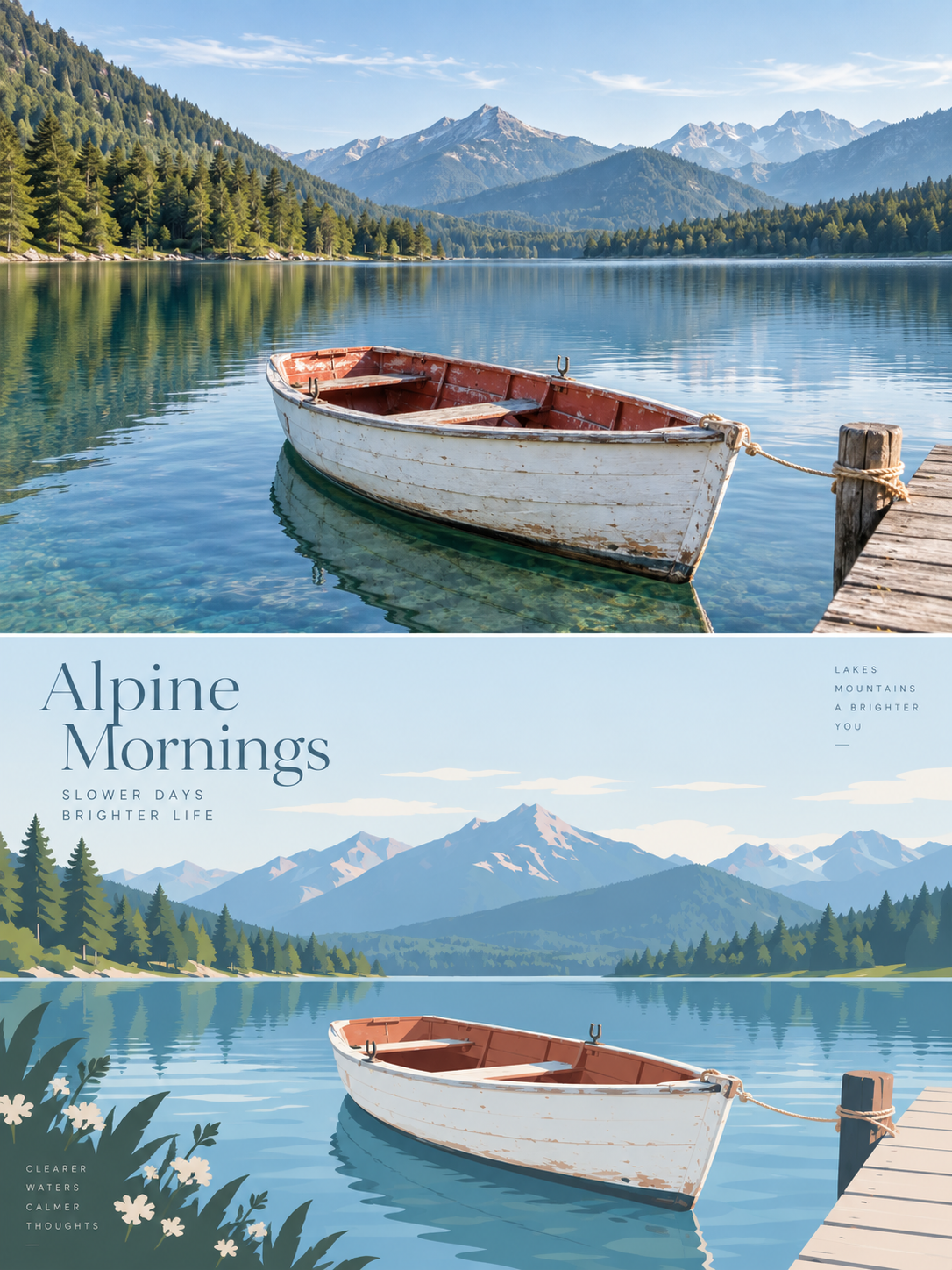
来自 OpenNana 的通用照片编辑模板。每张实际上传的源照片单独生成一张 3:4 上下分区旅行海报:上半部分保留原图,下半部分重构为独立的高级扁平矢量旅行海报。源照片为必填文件输入;来源示例图不被冒充为用户原图,未生成或绑定任何辅助素材。
提示词 / Prompt
中文提示词
图1是为source_photo生成的配套素材,作为本次编辑工作流对应位置实际使用的输入图像。 使用上传的源照片作为唯一的源输入。独立处理这张照片并输出一张海报;在文件实际上传前,不声称已经提供任何源图。 请将我上传的每张照片转换为一个单独的、独立设计的高级海报。不要制作拼贴画或合并多张图像——每张照片都应单独处理和输出。使用整体的 3:4 纵向构图,画布分为上下两个相等的部分,采用严格的 1:1 高度比例,各占图像的 50%。 上半部分应保留原始照片,保持主体的身份、结构、姿势、真实的纹理、自然的光线和原始的色彩氛围。仅应用细微、精致的摄影调色,使其具有艺术杂志、独立出版物或展览摄影的感觉。为了适应格式,如果需要,可以自然延伸天空、地面或环境背景,但主体不得被拉伸、扭曲或改变。 下半部分应从照片中提取最具辨识度的主体、轮廓、姿势和叙事关系,并将它们重构为一个高级简约扁平矢量旅行海报风格的插画场景。不要机械地描摹照片。相反,根据原始图像的视觉个性,提炼出最具代表性的主要视觉焦点,并围绕它构建 2–4 个辅助元素,以最好地表达环境的氛围、日常生活方式、地方感或生活状态。无论原始图像包含城市、建筑、人物、动物、植物、物体、车辆还是自然风光,下半部分都应感觉像是专门为该主体定制设计的高级旅行视觉海报,而不是套用在所有事物上的固定模板。 构图应根据主体自身的性格重新组织,而不是重复相同的布局。使用一个明确的焦点、清晰的前景-背景层次、适当的留白和冷静、有序的视觉节奏来构建图像。根据原始图像,场景可能会自然地转化为街道、广场、水边、庭院、通道、平台、植物环境、室内角落、开阔景观或带有日常生活痕迹的环境片段。主体必须始终保持为主要的视觉中心;所有其他元素应仅加强“这个地方 / 这个物体 / 这种情境”的独特性。避免拼贴式的地标堆砌、明信片式的罗列或过于叙事性的安排。如果场景中需要人物,仅包含 3–6 个小比例人物,自然地融入环境中,没有单一的主角。 整体风格应为高级简约扁平矢量插画:灵感来自日本文具美学、精品贴纸插画和现代编辑类旅行品牌设计。使用干净的几何形状、柔和的轮廓、一致的线宽、扁平色块和克制的细节。整体感觉应是清新、宁静、细腻且具有现代感。避免写实主义、厚重的阴影、水彩纹理、纸张纹理、复杂的笔触、渐变、拥挤的背景和过多的细节。 色调应基于柔和、轻盈、略显低饱和度的高级色板,可以通过提取并协调原始图像的整体色温进行调整,同时保持最终结果轻盈且凝聚。使用浅粉蓝、雾霾蓝、天蓝和轻盈的冷蓝色来构建主要氛围;用象牙白、奶白色、浅米色、柔和的灰绿色和建筑中性色来平衡它们。仅允许少量的灰粉色或柔和的浅粉色作为微妙的点缀——用于花朵、服装、小招牌、遮阳篷或局部装饰细节——使图像感觉透气但仍精致且富有层次感。 文字逻辑也应成为这种风格的一部分。不要简单地套用城市名称模板。相反,从原始图像的地点、物体名称、主题、状况或氛围中提取一个简短的标题,并将其放置在左上角或其他有大量留白的区域。为其配上一个简短、克制、有品位的标语。排版应保持低调、编辑风格、空间感和高级感,永远不要压过视觉效果。如有必要,添加少量的辅助文字、坐标式注释或微小的描述性说明,使文字感觉像是来自高级旅行品牌或精品明信片的自然视觉识别元素,而不是事后添加的标题栏。 整体效果应感觉像是专门为该主体设计的高级旅行海报 / 精品生活方式明信片:清新、优雅、宁静、现代且精致,具有大量的留白和轻松的临场感。每张海报的下半部分必须具有其独立的视觉身份——你绝不能在重复使用相同构图、相同前景或相同物体排列的同时仅仅更改名称。避免任何感觉像模板化、重复、通用或公式化的东西,如标准的旅游海报。
English prompt
Image 1 is the generated supporting image for source_photo; use it as the actual input for the corresponding slot in this editing workflow. Use the uploaded source photo as the sole source input. Process this photo independently and output one poster; do not claim that any source image has been supplied until the file is actually uploaded. Please turn each photo I upload into a separate, independently designed high-end poster. Do not make a collage or combine multiple images—each photo should be processed and output individually. Use an overall **3:4 vertical composition**, with the canvas divided into **two equal sections top and bottom**, in a strict **1:1 height ratio**, each occupying **50% of the image**. The **upper half** should preserve the original photo, maintaining the subject’s identity, structure, pose, authentic texture, natural lighting, and original color atmosphere. Only apply subtle, refined photographic color grading to give it the feel of an **art magazine, independent publication, or exhibition photography**. To fit the format, the sky, ground, or environmental background may be naturally extended if needed, but the main subject must **not** be stretched, distorted, or altered. The **lower half** should extract the most recognizable **subject, silhouette, pose, and narrative relationship** from the photo, and reconstruct them into a **premium minimalist flat-vector travel poster** style illustrated scene. Do not mechanically trace the photo. Instead, based on the original image’s visual personality, distill the most representative main visual focal point, and build around it with **2–4 supporting elements** that best express the atmosphere of the environment, the way of everyday life, the sense of place, or the state of living. Whether the original image contains a city, architecture, people, animals, plants, objects, vehicles, or natural scenery, the lower half should feel like a **custom-designed high-end travel visual poster** made specifically for that subject, rather than a fixed template applied to everything. Reorganize each lower-half scene around the source subject with one clear focal point, foreground/background layering, negative space, and a calm rhythm. Add only 2–4 supporting elements that express the place or situation. Avoid landmark stacking, postcard lists, repetitive layouts, or a single protagonist; if people are needed, use only 3–6 small integrated figures. The overall style should be **high-end minimalist flat vector illustration**: inspired by **Japanese stationery aesthetics, boutique sticker illustration, and modern editorial travel branding**. Use **clean geometric forms, soft contours, consistent line weight, flat color blocks, and restrained detailing**. The overall feeling should be **fresh, quiet, delicate, and contemporary**. Avoid realism, heavy shadows, watercolor textures, paper textures, complex brushwork, gradients, crowded backgrounds, and excessive detail. The color palette should be based on a **soft, airy, slightly desaturated premium palette**, which may be adjusted by extracting and harmonizing the overall color temperature from the original image, while keeping the final result light and cohesive. Use **light pink-blue, misty blue, sky blue, and airy cool blues** to build the main atmosphere; balance them with **ivory white, creamy white, light beige, soft gray-green, and architectural neutrals**. Only allow a small amount of **dusty rose or muted blush** as subtle accents—for flowers, clothing, small signs, awnings, or local decorative details—so the image feels breathable yet still refined and layered. The **text logic** should also become part of this style. Do not simply apply a city-name template. Instead, extract a **short title** from the original image’s **location, object name, theme, condition, or atmosphere**, and place it in the **upper left corner** or another area with generous negative space. Pair it with a **brief, restrained, tasteful tagline**. Typography should remain **understated, editorial, spacious, and premium**, never overpowering the visual. If necessary, add a small amount of secondary text, coordinate-style annotations, or tiny descriptive notes, so the text feels like a natural visual identity element from a **high-end travel brand or boutique postcard**, rather than a title bar added afterward. The result should feel like a fresh, elegant, quiet, modern, refined travel poster or boutique lifestyle postcard designed for this specific source photo. Preserve the source photo faithfully in the upper half and give the lower half an independent visual identity. Do not reuse the same lower-half composition, foreground, or object arrangement across different photos. Avoid templated, repetitive, generic, or formulaic tourism-poster results.
探索更多图片和视频提示词 · 生成图片 · 生成视频 · 在 AI 画布中创作
相关作品
- 夜兰花舞女
真人古装电影夜景剧照,一位约25岁的成年唐代美女在临水亭榭中轻盈起舞,脸庞丰润,身材丰满匀称,神情温柔。身穿月白色绣花抹胸与灰蓝色丝绸长裙,浅色披帛从臂弯延伸,发髻佩戴珍珠簪饰。她侧身抬臂,脚尖轻点地面,目光追随指尖,裙摆自然转动。背景可见深色水面、荷叶与木质栏杆,近处灯笼照亮脸庞和上身,柔弱的冷色夜光勾勒发丝与肩部轮廓。采用真实夜景电影色调,蓝灰环境色与少量暖黄灯光相互呼应,肤色保持自然,夜色深沉,黑位有层次,金属与水面反光不过曝。全身横向构图,水面倒影轻微破碎,保留低照度摄影的细腻颗粒,皮肤与布料质感真实。
- 牡丹春庭
真人古装电影剧照,一位约25岁的成年盛唐美女在牡丹庭院中翩翩起舞,面容明媚,胸部丰满,体态丰腴柔美,腰腹曲线自然。身穿藕粉色刺绣抹胸、浅绯色长裙与米杏色披帛,云鬓间簪一朵牡丹。她轻盈转身,抬手展腕,笑容松弛自然,披帛与裙摆沿着动作方向扬起。庭院里可见真实的花枝、青石小径、木窗与斑驳墙面,柔和春日天光照亮人物,树叶投下疏淡阴影。真实电影色彩,粉色柔和,叶片呈自然灰绿色,肤色通透但保留细微色差,白色与浅色衣料保留纹理,高光不过亮,整体对比适中,带细微胶片颗粒。平视全身构图,环境有清晰空间层次,无浓重滤镜、无人工光晕、无蜡像肤质。
- 大唐舞女-1
真人古装电影剧照,一位约25岁的成年唐代美女在宫殿中翩翩起舞,五官明艳,体态丰腴,胸部丰满,肩颈圆润,身体比例自然。身穿暗朱红色金线刺绣抹胸与柔软的香槟金长裙,披帛绕过双臂,高髻佩戴精巧金步摇。她旋身回眸,双臂舒展,裙摆随动作展开,衣料呈现真实重量、褶皱和垂坠感。背景是木质宫柱、屏风与石砖地面,侧面宫窗透入柔和日光,殿内保留自然阴影。真实电影调色,暗红沉稳,金色克制,肤色自然偏暖,高光柔和过渡,暗部保留木纹与衣料细节,带轻微胶片颗粒。平视全身构图,人物完整入镜,面部清晰,飞扬的披帛边缘带少量运动模糊,保留皮肤毛孔与细小绒毛,无磨皮、无CG感。
- 清水寺极简手绘旅行海报
日式建筑速写风格的方形旅行海报。准确中文默认值:清水寺、京都、日本;英文默认值:KIYOMIZU-DERA TEMPLE、Kyoto、JAPAN。画面仅有一位绑定固定参考 ref-10a-v1 的远景游客。
- 飞雪
A beautiful East Asian fairy maiden in a quiet snow field at blue hour, framed as a close three-quarter portrait. Soft layered white and ash-grey robes fall loosely around her shoulders; fine silk catches a faint breeze. Cold open winter light wraps her face gently—clear eyes, natural skin, a few lo
- 换装
人物以图二为准:同一张脸、同一发型、同一体型与姿态角度,服装以图一为准,包括款式、版型、面料质感、颜色与配饰细节。整体色温、影调与鲍和度倾向向图一靠拢,写实摄影质感。 参考图 A(图二)提供人物主体与构图,参考图 B(图一)提供服装与色调。把画面中女人的服装完整替换为参考图 B 中的整套服饰,不保留参考图二的任何服装,保持款式、版型、面料质感、颜色与配饰细节与参考图 B 一致,衣料自然贴合身体与动作。人物保持参考图 A 的面部特征、发型、体型、姿态与拍摄角度不变,不改动她的身份与表情。整体色调、色温、光线方向和影调统一到参考图 B 的氛围,背景图一不变。写实摄影质感,细节清晰,无明显合成痕迹